
Six years ago, I was a brand new bride, just back from our honeymoon and facing a new world of unemployment in a small town in PA, with no one like me (i.e., NOT from Johnstown) in sight.
The ringing phone woke me up, but the sound of my mother-in-law’s frantic voice was like a knife in my brain when she said, “Jessica, we’re under attack. America is under attack. Turn on the TV.”
I thought she was being sensational. But I turned on the TV in time to see the first tower in flames and then watch the second plane hit. In that moment, it was as if my two worlds were colliding together—my home world of the burning tires and exploding buses and army jeeps and sirens and my new world of sitcoms and department store sales and autumn leaves—were suddenly crunching against each other, metal against concrete. This was not supposed to happen. I couldn’t believe it. Why then, did another part of my mind recognize the image, as if I had seen it a hundred times before?
We are in the middle of Nowhere, PA, not in Jerusalem anymore, not even in Washington DC anymore. I tried to reassure my mother-in-law that we would not be the next targets. Why then, was I getting a call from my husband that his governmental agency, fifteen minutes away, was under an emergency evacuation and that the local airport (which has only one possible destination, Pittsburgh, for little baby commutes) had spotted a rogue plane and had called in the National Guard? What could a terrorist possibly want in Johnstown, PA? Don’t be ridiculous.
We formed a plan. Meet at the top of the hill at my parents-in-law’s house. Say up there until crisis is over. Stay off the phones. Watch TV.
So, we watched while the Pentagon burned. And then we watched while the news reported another plane down, a few miles away in a field by a mine. By the news reports, it had flown right over our heads.
We spent the day in one room, glued to the TV, staring in stunned disbelief, weeping. And then the questions started. Why do they hate us, my brother in law asked me, what have we done to deserve such a thing? Who are these monsters? How can someone from the other side of the world hate us enough to do this to us?
I remember being alone. I remember many talks with many people and that I was always alone. I remember the friends and family members who vowed to protect me from vigilante justice, who told me that I needed to stay low, stay at home, avoid the grocery store and maybe even church. They tucked me under their wings and told me that they would keep me safe and that they loved me. I sat on their couches, listening to them ask the questions that I was not asking . . . and while they reeled from this “loss of virginity,” from experiencing the unthinkable, I remembered: the gas masks, the missiles, the tanks on our streets, the burning flags, the twisted bus skeletons, the machine guns, the bullet holes, the curfews, the strikes, the marches, the tear gas, the shattered car windows, the broken arms, the checkpoints, the stabbing in front of my elementary school, the spray-painted graffiti on our front door, the feeling that you are not protected and that if They were to get you and kill you, would anyone really make a fuss?
Tuesday, September 11, 2007

Wednesday, September 5, 2007
Prayer of Paradox
For those of you who already know me, you know that I am a little obsessive about the role of paradox and faith. Imagine my delight, then, when I found this little prayer in a Puritan prayer book while preparing for my new American literature class! I think I'm going to bring it in tomorrow to class.
The Valley of Vision
LORD, high and holy, meek and lowly,
Thou has brought me to the valley of vision,
where I live in the depths but see thee in the heights;
hemmed in by mountains of sin I behold thy glory.
Let me learn by paradox
that the way down is the way up,
that to be low is to be high,
that the broken heart is the healed heart,
that the contrite spirit is the rejoicing spirit,
that the repenting soul is the victorious soul,
that to have nothing is to possess it all,
that to bear the cross is to wear the crown,
that to give is to recieve,
that the valley is the place of vision.
Lord, if the daytime stars can be seen from deepest wells,
and the deeper the wells the brighter thy stars shine;
Let me find thy light in my darkness,
thy life in my death,
thy joy in my sorrow,
thy grace in my sin,
thy riches in my poverty,
thy glory in my valley.
Tuesday, September 4, 2007
Classroom Prayer
Eternal and ever loving Father,
I offer you everything I do this day:
my work, my prayers, my play, all my thoughts,
my time with family and friends,
my hours of study and of relaxation,
my difficulties, problems, distresses,
which I shall try to bear with patience.
Join these, my gifts, to the unique offering
which Jesus Christ, your Son, renews daily through his Body and Blood.
Grant, I pray, that guided by the Holy Spirit
and united to the Sacred Heart of Jesus,
my life this day may be of service to you,
and to all you send into my life,
so that we can continue to respond with love
to the mystery of your call,
to be your special people. Amen.
Leader: Heart of Jesus burning with love for us
Response: Enflame our hearts with love for you.
Friday, August 17, 2007
Wait, what happened to my wallet?
Apparently, we did not think that our sugar baby was getting enough money, so yesterday we decided to up Israel's allowance to a a cool thirty billion dollars over the next ten years. That's a twenty-five percent increase over our last figures. Last I checked, we give Israel more money than every other country combined, so I wonder where this latest number puts us.
But don't worry, we're going to balance it out by giving about twenty billion dollar in arms to some Arab allies (Egypt and Saudi are on our Top Friends list).
By the way, remember how this administration was determined to ONLY deal with democracies and was not going to use weapons sales to court foreign powers? Wasn't that their policy for years now? I wonder what happened to change their mind . . .
Tuesday, August 14, 2007
George MacDonald
A reading from George MacDonald's Diary of an Old Soul:
I am a fool when I would stop and think,
And lest I lose my thoughts, from duty shrink.
It is but avarice in another shape.
‘Tis as the vine-branch were to hoard the grape,
Nor trust the living root beneath the sod.
What trouble is that child to thee, my God,
Who sips thy gracious cup, and will not drink!
George MacDonald (184-1905) was a Scottish novelist, poet and theologian. I adore his fairy tales, particularly: The Wise Woman, The Golden Key, The Princess and the Goblin, The Princess and Curdie, and most especially, Phantastes, a grown-up fantasy that C.S. Lewis declared “baptized his imagination” before he became a Christian. Most writers are excellent in their depiction of vice—of our human follies, deceits and illogicality. MacDonald is the only writer I have read who captures goodness and beauty and innocence without making it seem naïve and childish.
I picked up a copy of Diary of an Old Soul, which has a little devotional poem for each day of the year. I don’t always understand them and I don’t read them regularly, but every once in a while, I run across a little gem like this.

I am a fool when I would stop and think,

And lest I lose my thoughts, from duty shrink.

It is but avarice in another shape.
‘Tis as the vine-branch were to hoard the grape,
Nor trust the living root beneath the sod.
What trouble is that child to thee, my God,
Who sips thy gracious cup, and will not drink!
George MacDonald (184-1905) was a Scottish novelist, poet and theologian. I adore his fairy tales, particularly: The Wise Woman, The Golden Key, The Princess and the Goblin, The Princess and Curdie, and most especially, Phantastes, a grown-up fantasy that C.S. Lewis declared “baptized his imagination” before he became a Christian. Most writers are excellent in their depiction of vice—of our human follies, deceits and illogicality. MacDonald is the only writer I have read who captures goodness and beauty and innocence without making it seem naïve and childish.
I picked up a copy of Diary of an Old Soul, which has a little devotional poem for each day of the year. I don’t always understand them and I don’t read them regularly, but every once in a while, I run across a little gem like this.
Monday, August 13, 2007
Arms Outspread
All right, so autumn is starting to creep up my back (don’t you just hate August) and this is making me a little pensive. Back to the passage from Hebrews for a little while.
All of these people were still living by faith when they died. They did not receive the things promised; they only saw them and welcomed them from a distance.
I just read through a biography of Anne Bradstreet, the first American poet (a surprisingly favo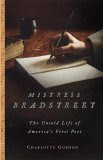 rite read—quick, fascinating, story-like) and was able to step into the shoes of a Puritan woman in a way that I have never been able to do before. She and her family had a dream, a dream of holiness, a dream that a society could be designed in such a way that every person within its community would bow to the authority of God. They were deeply passionate about this dream, and they believed that this was a God ordained dream. To disregard would be to disobey. For the first time, I realize the immensity of the sacrifice. These people had nothing to gain and everything to lose. They sold everything—property, goods, businesses, lace collars—to buy supplies to live through journey. There would be no money for a return trip.
And of course, they compared themselves to Abraham, and they compared the New World to the Promised Land. This was the dream that was promised to Abraham, though, as this passage indicates, he died without seeing.
Within one generation, the Puritan dream withered. In fact, the dream was tainted from conception because they had to bring outsiders with them because they needed particular tradesmen (doctors, carpenters, etc.) and there weren’t enough Puritan tradesmen to go around. So Idealism bowed to Practicality before they even set sail. Not only that, but their community unity was attacked again and again, not by outsiders as much as by insiders who strayed from the straight and narrow. Each time the community was shaken up by religious or political controversy, another small group would break off and move further away from the frontier, to start fresh and restart the limping dream.
I look at these two stories, of Abraham’s life of faith with unfulfilled promises and the American template of faith: wanting, demanding for the promises to be fulfilled now. I think, what is this faith that we are called to—to be always haunted by the beauty of the dream but to know that it is stamped with the designation not yet? What is this faith that we are called to—to be given the vision, to know the outline of the Garden of Eden, to have glimpses of glory, and yet to be still so far away? Our attempts to hammer in the garden seem to turn in to nightmares.
My question for myself is: will I be patient? Do I have what it takes to stand with the faithful? Am I content enough
To see (and taste and drink and smell)
And welcome (arm outspread)
From a distance.
All of these people were still living by faith when they died. They did not receive the things promised; they only saw them and welcomed them from a distance.

I just read through a biography of Anne Bradstreet, the first American poet (a surprisingly favo
 rite read—quick, fascinating, story-like) and was able to step into the shoes of a Puritan woman in a way that I have never been able to do before. She and her family had a dream, a dream of holiness, a dream that a society could be designed in such a way that every person within its community would bow to the authority of God. They were deeply passionate about this dream, and they believed that this was a God ordained dream. To disregard would be to disobey. For the first time, I realize the immensity of the sacrifice. These people had nothing to gain and everything to lose. They sold everything—property, goods, businesses, lace collars—to buy supplies to live through journey. There would be no money for a return trip.
And of course, they compared themselves to Abraham, and they compared the New World to the Promised Land. This was the dream that was promised to Abraham, though, as this passage indicates, he died without seeing.
Within one generation, the Puritan dream withered. In fact, the dream was tainted from conception because they had to bring outsiders with them because they needed particular tradesmen (doctors, carpenters, etc.) and there weren’t enough Puritan tradesmen to go around. So Idealism bowed to Practicality before they even set sail. Not only that, but their community unity was attacked again and again, not by outsiders as much as by insiders who strayed from the straight and narrow. Each time the community was shaken up by religious or political controversy, another small group would break off and move further away from the frontier, to start fresh and restart the limping dream.
I look at these two stories, of Abraham’s life of faith with unfulfilled promises and the American template of faith: wanting, demanding for the promises to be fulfilled now. I think, what is this faith that we are called to—to be always haunted by the beauty of the dream but to know that it is stamped with the designation not yet? What is this faith that we are called to—to be given the vision, to know the outline of the Garden of Eden, to have glimpses of glory, and yet to be still so far away? Our attempts to hammer in the garden seem to turn in to nightmares.
My question for myself is: will I be patient? Do I have what it takes to stand with the faithful? Am I content enough
To see (and taste and drink and smell)
And welcome (arm outspread)
From a distance.
Thursday, August 9, 2007
Walking on Water

Thank you so much, Laura!
I am so new at this that I didn’t realize that one could get awards on here and had to take a peak at other people’s blogs to understand the proper protocol. My dear friend Laura, (My Quotidian Mysteries), is a brave soul who has just moved to Qatar. Here is what she said:
Jessica is another friend who also recently started a blog (On the Outside of the World), and I'm so glad she did. She's a friend of mine from college, and she's an American Palestinian Christian. Yep. You read that correctly. One thing I love about Jessica is that she slays all stereotypes. She's a teacher at a classical Christian school, and is passionate about Jesus Christ and about her heritage as a Palestinian. She's thoughtful and courageous in discussing politics in the Middle East (or anything else for that matter) and her courageous soul blesses me.
As for being courageous, I will say this: I have been described by those who know me best (namely my mother) as being risk-adverse. I am a saver, an organizer, and a planner. But all of the best things of my life have come from the wild calls of God, and my almost stupefied “yes.”
I think of traveling across the ocean to go to college by myself in the United States. I think of a crazy decision to move to D.C. after college, where I knew almost no one and when I had no money. Then to Johnstown, PA, again, with no job and where I was a complete misfit (was I even sane at this point?) Then there was the decision to teach, (with NO prior experience), to put on two plays (with NO prior experience), even to take some students with me to work in the deepest part of the West Bank (seriously, were those parents sane?) I think, also, of engaging in friendships and discussions with the many people who are either subtly or overtly opposed to my very identity, racially, politically and theologically.
All of these things required me to step out, to commit, to say, “yes” before I knew if I could really do it—no, actually knowing that I couldn’t do it, but that God wanted me to do it anyway. All of these things required me to step out on the water, to actually walk on the water. It seems that as long as I am staring at the face of God and walking toward Him, I am giddy but fine. My stress comes from these moments of panic when I look down and realize that I am walking on water and say to myself, ‘What in the world am I doing? I can’t do this!” and I start to sink.
This is what my life seems to be about: getting out of the boat when Jesus calls, walking on the water, doubting, and then feeling Jesus pull me up and holding me until I can walk again.
Subscribe to:
Posts (Atom)